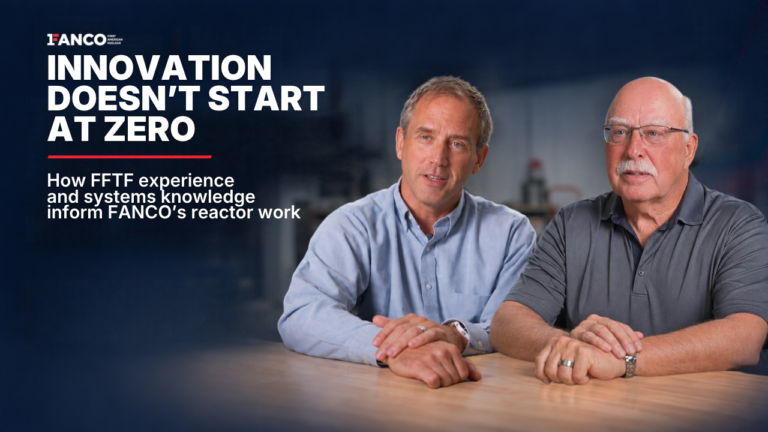
Al Farabee draws on more than five decades of nuclear industry experience to explain how coolant selection creates opportunities to simplify reactor systems and reduce costs.
Two nuclear reactors can operate within the same fast-spectrum category and still have fundamentally different engineering requirements.
Sometimes, that difference comes down to the coolant.
For First American Nuclear, selecting lead-bismuth for its EAGL-1 small modular reactor reflects a practical engineering priority: designing around affordability.
Lead-bismuth’s chemical properties create opportunities to eliminate the intermediate cooling loop commonly used in sodium-cooled reactors. Removing that loop can reduce equipment, simplify construction, and lower associated maintenance requirements.
Al Farabee brings a valuable perspective to evaluating those opportunities.
With more than 55 years of experience across commercial nuclear power, naval reactor systems, and the Fast Flux Test Facility (FFTF), Farabee has worked with nuclear technology through multiple stages of development and operation.
Today, he is applying that experience to FANCO’s EAGL-1.
What Sodium Reactors Have Taught Engineers
Sodium-cooled fast reactors have played an important role in advancing nuclear technology.
The Fast Flux Test Facility in Richland, Washington, provided experience with liquid-metal reactor systems, fuel handling, plant operations, and the practical requirements of operating a fast-spectrum reactor.
Farabee’s involvement with FFTF included its startup period beginning in 1979, full-power operations in the early 1980s, and later operational and facility activities.
That background gives him firsthand insight into the relationship between reactor design and real-world performance.
Sodium transfers heat efficiently at elevated temperatures, making it useful as a reactor coolant. Its chemical reactivity, however, introduces additional requirements that affect plant complexity and cost.
Understanding both characteristics helps engineers evaluate how lessons from sodium-cooled reactors can inform a different approach.
How Coolant Chemistry Affects Plant Cost
One of the most significant distinctions between sodium and lead-bismuth is how they interact with water.
Sodium reacts vigorously with water and can burn when exposed to air. Managing those hazards requires protective equipment and specific design measures.
Conventional sodium-cooled fast reactors commonly include an intermediate heat-transfer loop separating the primary reactor coolant from the water and steam systems used to generate electricity.
That additional loop introduces heat exchangers, pumps, piping, instrumentation, and supporting equipment. Those components must be engineered, manufactured, installed, inspected, and maintained, adding to the plant’s cost.
Lead-bismuth does not undergo sodium’s energetic reaction with water. This allows engineers to consider heat-transfer arrangements that eliminate the intermediate loop and its associated equipment.
For EAGL-1, that distinction creates an opportunity to simplify the plant and reduce the construction and maintenance costs associated with an additional cooling circuit.
The economic opportunity comes from the overall system configuration. Fewer components and interfaces can mean less equipment to procure, install, and maintain.
Simplification Requires Careful Engineering
Eliminating an intermediate loop does not eliminate the need for engineered safety systems.
Lead-bismuth has its own requirements, including coolant chemistry management, corrosion control, materials compatibility, and temperature management. Engineers must also evaluate and manage the consequences of potential water or steam leaks.
These considerations remain integral to EAGL-1’s development.
The value of lead-bismuth lies in the opportunity to address those requirements within a simpler heat-transfer configuration, avoiding equipment needed specifically to manage sodium’s chemical reactivity.
For FANCO, evaluating that tradeoff is part of designing the complete plant around reliable operation and affordability.
Why Thermal Efficiency Matters
Another consideration Farabee emphasizes is thermal efficiency: how effectively a power plant converts reactor heat into electricity.
A plant operating at 40% thermal efficiency, for example, converts 40% of its thermal energy into electrical energy, with the remainder rejected as waste heat.
Liquid-metal fast reactor systems can support elevated operating temperatures, creating opportunities for improved power-conversion efficiency.
Higher thermal efficiency means generating more electricity from a given quantity of reactor heat. It is one of several factors that influence plant performance and economics.
Efficiency depends on more than coolant selection. Operating temperatures, the power-conversion cycle, and the performance of the integrated plant all play a role.
For EAGL-1, FANCO’s 240 MWe fast-spectrum small modular reactor, thermal efficiency and system simplification are connected engineering objectives. Both require evaluating how the reactor and its supporting systems function together.
Experience Changes How Engineers Evaluate Design Decisions
Coolant selection affects thermal systems, component requirements, operating conditions, maintenance needs, and equipment interfaces.
Farabee’s experience helps connect those design considerations with the realities of an operating nuclear facility.
A component must meet its technical specifications while also being practical to install, operate, inspect, and maintain. Decisions that appear straightforward in a design can have lasting consequences throughout a plant’s life.
Experience with liquid-metal reactor systems helps engineers ask those practical questions early.
For FANCO, that means evaluating lead-bismuth’s properties alongside lessons from earlier reactor programs, using established knowledge to inform where systems can be simplified and where focused engineering is required.
Applying the Lessons to EAGL-1
EAGL-1’s lead-bismuth coolant is central to FANCO’s approach to developing an advanced reactor with affordability in mind.
By avoiding sodium’s energetic water-reaction hazard, lead-bismuth creates an opportunity to eliminate an intermediate cooling loop and reduce the equipment and work associated with it.
Turning that opportunity into a functioning plant requires detailed engineering, materials evaluation, testing, and system integration. The resulting economics will depend on the performance and cost of the complete design.
For Farabee, that work builds on decades of experience understanding how nuclear technology performs beyond the design stage.
For FANCO, it reflects a guiding priority: applying that experience to engineering decisions that can make the next generation of nuclear power more practical to build, operate, and maintain.