Fuel today and a better future tomorrow
ENERGY SECURITY WITHIN REACH
An established fuel form for initial deployment
The initial commercial configuration of EAGL-1 is being developed to use uranium dioxide fuel containing uranium enriched to high-assay low-enriched uranium (HALEU) levels. Uranium dioxide is a well-established fuel form with decades of use in commercial reactors worldwide.
This fuel choice allows FANCO to build on extensive industry experience while preserving the intended benefits of a fast-spectrum reactor. Fuel qualification, manufacturing, and licensing remain central to the EAGL-1 development program.
EAGL-1’s initial commercial deployment does not depend on the additional fuel-cycle capabilities the platform may support in the future.
INITIAL FUEL
Uranium Dioxide
Uranium dioxide (UO₂) is the most widely used ceramic nuclear fuel in commercial reactors and has also been demonstrated in liquid-metal fast reactor service. That operating history matters: compared with more exotic fuel forms, UO₂ benefits from a much deeper base of manufacturing experience, irradiation data, fuel-performance models, quality standards, and licensing familiarity.
For EAGL-1, that makes HALEU UO₂ a practical first fuel choice. It allows FANCO to pair a Generation IV fast-spectrum reactor with a fuel form that is already well understood, reducing unnecessary fuel-development risk while preserving a pathway to more advanced fuels later as the program matures.
FUEL MADE IN AMERICAN FOR ADVANCED REACTORS
Building the domestic fuel supply advanced reactors need
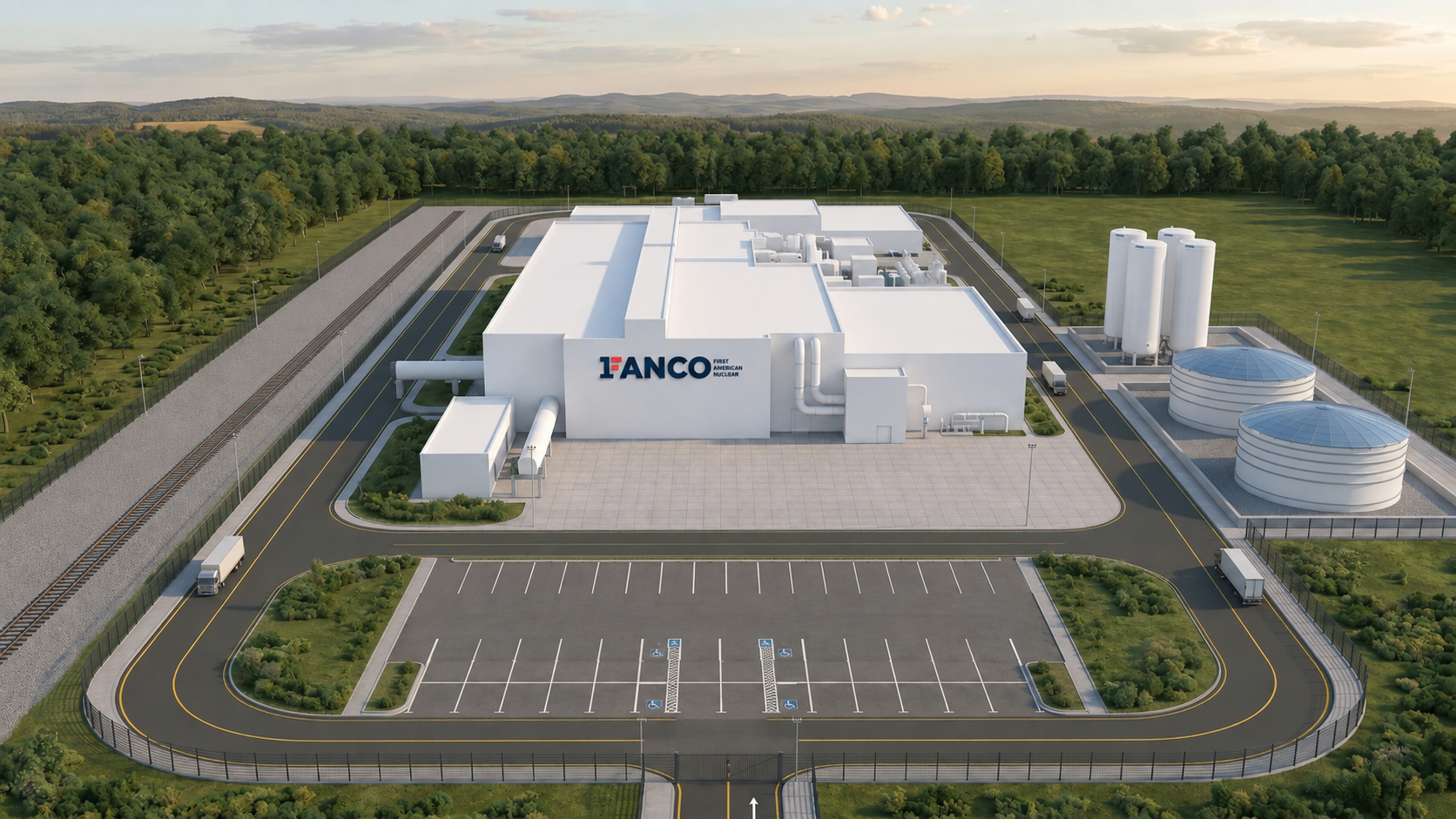
FANCO is developing a domestic Category II HALEU fuel fabrication facility to support EAGL-1 and other advanced reactor customers. The facility is being designed to fabricate uranium oxide fuel and to provide capability for converting uranium oxide into other fuel forms as the advanced reactor market develops.
FANCO has formally notified the U.S. Nuclear Regulatory Commission of its intent to pursue licensing under 10 CFR Part 70 and has requested pre-application engagement, including docketing, project management, technical review planning, and licensing coordination.
The goal is to help close a critical gap in the U.S. nuclear fuel supply chain by creating a secure, American-owned source of finished advanced reactor fuel while also supporting future fuel-cycle technology development.
NRC LICENSING STATUS
Regulatory engagement and facility design underway
FANCO has formally notified the U.S. Nuclear Regulatory Commission of its intent to pursue licensing under 10 CFR Part 70 for a Category II HALEU fuel fabrication facility supporting EAGL-1 and other advanced reactor customers. FANCO has also requested pre-application engagement to support docketing, technical review planning, pre-application meetings, and development of a licensing project plan.
In parallel, facility design is underway using proven uranium-processing and fuel-fabrication processes, established systems, and commercially demonstrated technologies wherever practical. The objective is to build on existing industrial experience rather than introduce unnecessary process-development risk, while incorporating the safeguards, safety controls, environmental protections, and management measures required for a modern Category II fuel facility.

FANCO’s proposed fuel facility is being designed not only to fabricate HALEU uranium oxide fuel, but also to support deconversion of enriched uranium into other fuel forms.
ONE REACTOR. MULTIPLE FUTURE FUEL PATHWAYS
Fuel Flexibility
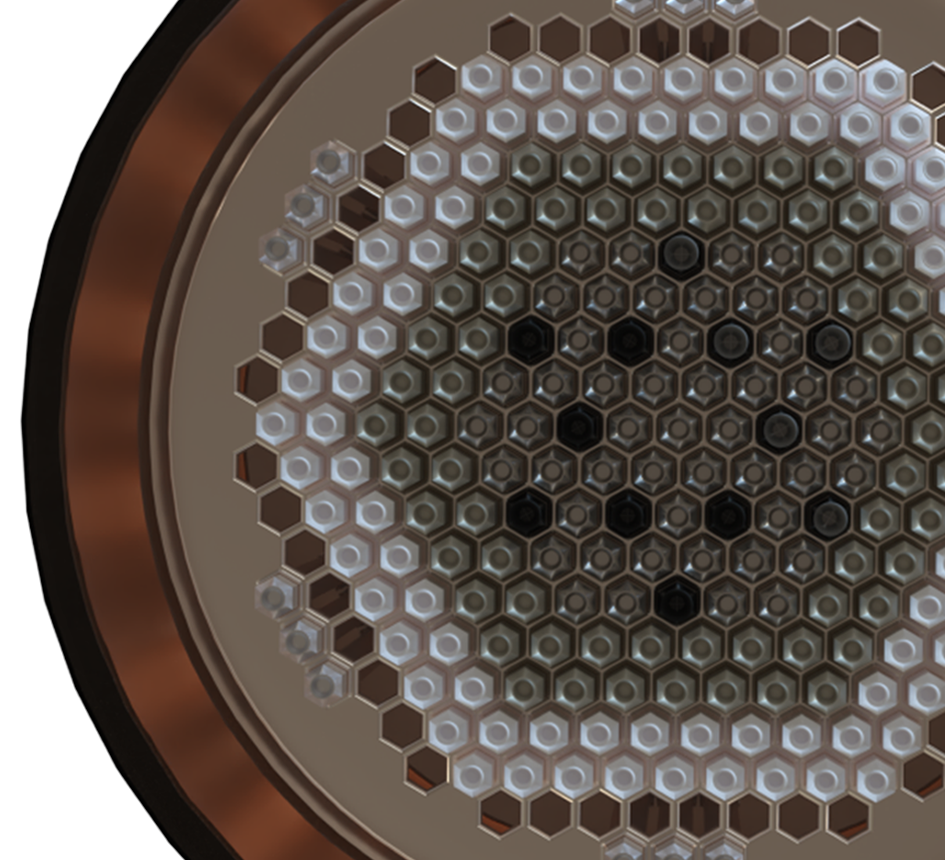
Fast-spectrum reactors like EAGL-1 can operate using a broader range of nuclear materials than conventional light-water reactors. EAGL-1 is being deliberately engineered to preserve the ability to support additional fuel types in future configurations, including:
- Mixed-Oxide fuel (MOX)
- Recycled uranium
- Transuranic-bearing fuel (TRU)
- Fuel derived from existing nuclear material inventories
Each future fuel configuration would require testing, qualification, safety analysis, and regulatory approval. The value of fuel flexibility is not that every fuel is available immediately. It is that the EAGL-1 platform is not intended to depend permanently on a single fuel pathway; These future capabilities are not required for initial EAGL-1 deployment.
FUEL RECYCLING
Recovering more energy from used nuclear fuel
Conventional U.S. reactors use only a small portion of the potential energy contained in nuclear fuel before it is removed from the reactor and placed into storage. The material being stored is currently being managed as nuclear waste at sites across the United States. However, this used fuel contains valuable material that could potentially be recovered, recycled, and made into new nuclear fuel. Fast-spectrum reactors like EAGL-1 create the opportunity to recover substantially more of that remaining energy.
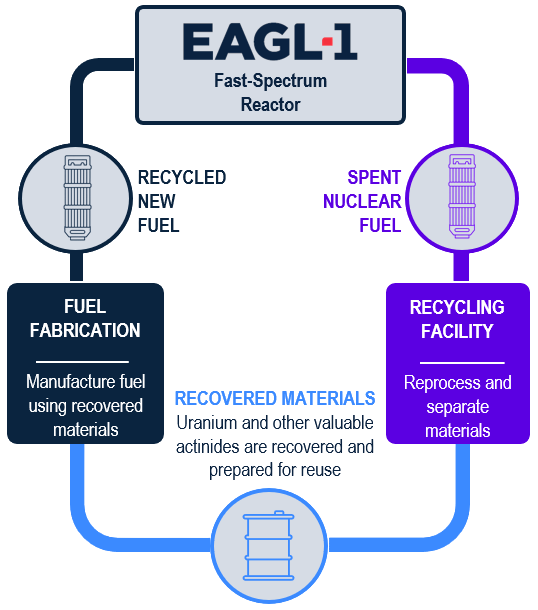
Future EAGL-1 configurations could be paired with advanced fuel-recycling systems that process used nuclear material into new reactor fuel. This could reduce demand for newly mined uranium, make use of existing nuclear-material inventories, and decrease the quantity and long-term burden of material requiring disposal.
Practicality now, with an eye toward what’s possible
In the near term, FANCO is focused on developing and deploying a commercially practical reactor. Over time, EAGL-1 technology and the FANCO deployment platform could also support a more secure, efficient, and sustainable approach to delivering nuclear energy. While this is a longer-term capability planned for EAGL-1, it is not required for the initial deployment of the reactor.
THE CLOSED FUEL CYCLE FUTURE
A foundation for recycling and reusing nuclear fuel
The traditional nuclear fuel cycle is a one-way process, or open fuel cycle. In an open cycle, fuel is used, removed from the reactor, and stored as waste. Incredibly, that spent fuel still contains significant usable energy.
Alternatively, in a closed fuel cycle, fuel is repeatedly reprocessed and recycled, allowing it to be reused as fuel and more than 90% of the fissionable material to be converted into energy, reducing the amount of material that requires long-term storage.
Well-understood science and technology
Closing the fuel cycle is not a distant aspiration. The science and technology have been demonstrated, and the fuel already exists.
While EAGL-1’s fast-spectrum architecture is intended to support a future closed fuel cycle, doing so would require recycling facilities, qualified fuel-fabrication capabilities, appropriate safeguards, and additional regulatory approvals.
A closed nuclear fuel cycle could help the United States expand clean nuclear energy, strengthen long-term energy security, and reduce the amount of
nuclear waste requiring permanent disposal. By making better use of existing fuel resources, America could support reliable nuclear power at scale while advancing energy security at home and abroad.
ENERGY SECURITY
A platform designed for the long term
EAGL-1 is being developed first as a practical source of reliable, utility-scale electricity. Its broader value lies in the options created by its fast-spectrum architecture.
- The ability to use multiple fuel pathways
- The potential to recover more energy from nuclear material
- Reduced dependence on a single long-term fuel supply
- The potential to consume transuranic materials
- Future integration with advanced fuel recycling
Together, these capabilities could help strengthen domestic energy security, reduce long-term fuel-cycle constraints, and restore U.S. leadership in advanced nuclear technology.