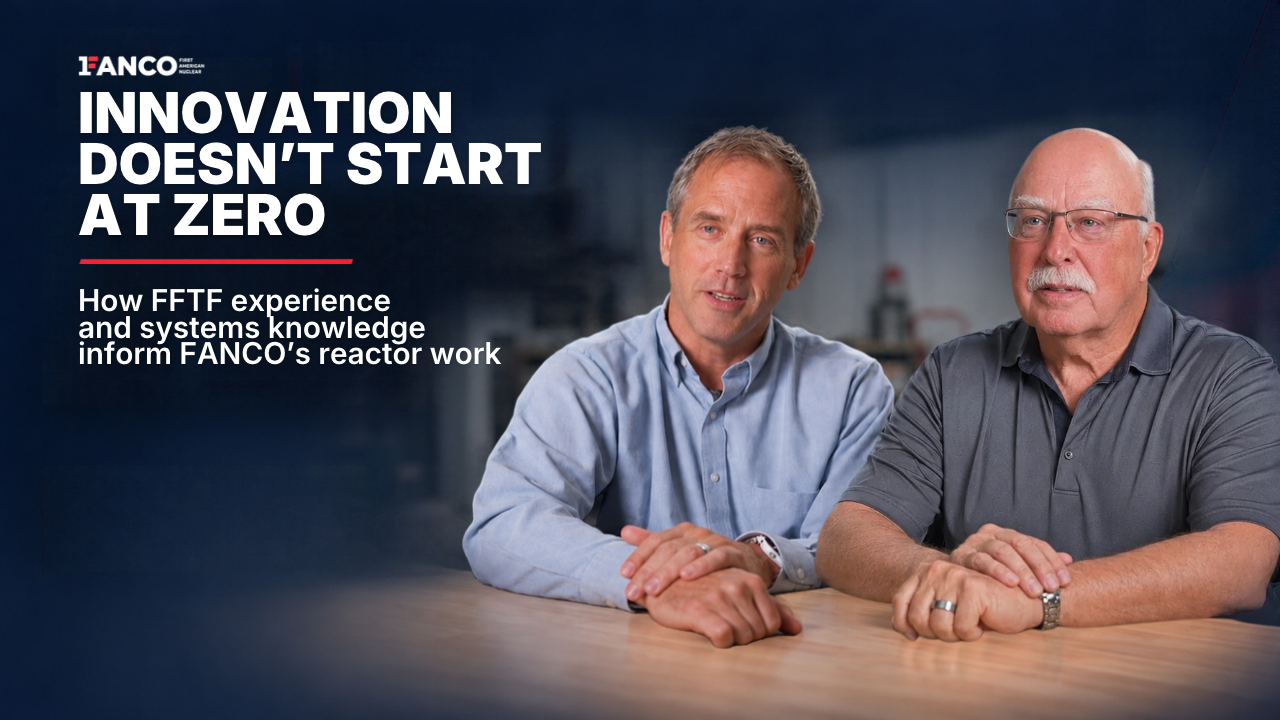
How experience designing, building, operating, and maintaining fast reactor systems helped shape today’s small modular reactor designs and brought FANCO’s engineers together to develop EAGL-1.
Innovation in nuclear energy builds on knowledge gained through decades of engineering, construction, and operations.
For members of First American Nuclear Co.’s (FANCO) engineering team, that experience includes helping design, build, operate, and maintain systems at the Fast Flux Test Facility (FFTF), a sodium-cooled fast reactor operated under the U.S. Department of Energy.
They carried that knowledge into the development of today’s small modular reactor designs before coming together to design EAGL-1, FANCO’s 240 MWe lead-bismuth-cooled fast-spectrum small modular reactor.
That progression connects firsthand experience with the practical requirements of developing a new nuclear power plant.
Experience Across the Life of a Reactor
Advanced reactor development involves thousands of interconnected engineering decisions. Each component must meet its own requirements while functioning within a larger system.
Understanding those relationships requires knowledge of how equipment is designed and built, how it performs during operation, and what it takes to maintain it over time.
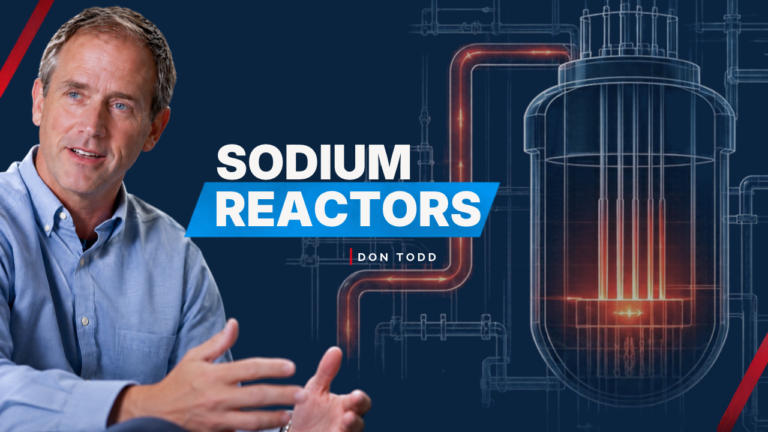
As Don Todd, FANCO’s Vice President of Nuclear Engineering, explains in the accompanying video:
“Nobody starts from a white sheet of paper.”
Members of FANCO’s engineering team bring experience spanning the design, construction, operation, and maintenance of FFTF systems. Those responsibilities provided different but connected perspectives on the same facility.
Designing systems required translating technical requirements into detailed engineering. Building them required resolving questions of fabrication, installation, and integration. Operating and maintaining them revealed how those decisions affected equipment performance, accessibility, and reliability.
Together, those experiences provide a practical foundation for evaluating new reactor designs.
Lessons From the Fast Flux Test Facility
Located at the U.S. Department of Energy’s Hanford Site in Washington, FFTF was a sodium-cooled fast neutron test reactor developed to support research and testing of fast reactor fuels, materials, and technologies.
For FANCO engineers involved in its systems, FFTF provided an opportunity to understand how a fast reactor facility comes together and functions over time.
Their experience extended across equipment performance, system interfaces, operating requirements, and maintenance needs. It also demonstrated how decisions made during design and construction could influence later operations.
That knowledge has lasting value. Engineers who understand how systems were built, why particular decisions were made, and how equipment performed can bring those lessons into subsequent projects.
FFTF became an important part of the engineering foundation these team members carried forward throughout their careers.
Carrying That Knowledge Into SMR Development
The experience gained at FFTF continued to inform these engineers’ work as they contributed to the development of today’s small modular reactor designs.
Moving into new reactor programs meant applying established knowledge to different technologies, configurations, and deployment objectives. Each design introduced its own requirements, while drawing on lessons about how complex nuclear systems are constructed, operated, and maintained.
That work expanded their experience beyond a single facility. It connected the practical lessons of FFTF with the engineering challenges facing a new generation of reactors.
Members of this team then came together at FANCO to design EAGL-1, bringing knowledge developed across those successive programs.
EAGL-1’s development draws on that full progression: firsthand fast reactor experience, its application to subsequent SMR designs, and the engineering judgment gained along the way.
Designing EAGL-1 With the Whole Plant in Mind
A reactor component must do more than satisfy an individual technical specification. It must function within a coordinated plant, with requirements for installation, operation, inspection, maintenance, and integration with surrounding equipment.
Experience across those activities helps engineers consider how a design will function throughout the plant’s life.
How will equipment be installed? Can it be accessed for maintenance? How will one system interact with another? What operational requirements need to be addressed during design?
These questions help guide FANCO’s development of EAGL-1.
The team’s experience supports an approach that considers construction, operations, and maintenance early in the engineering process. It helps connect design objectives with the practical requirements of a functioning power plant.
Applying Fast Reactor Experience to a New Design
EAGL-1 is being developed as a lead-bismuth-cooled fast-spectrum reactor. FFTF used sodium coolant, so the two designs have distinct technical requirements.
Experience from FFTF provides relevant knowledge of fast reactor systems and liquid-metal technologies, while EAGL-1 requires engineering specific to its coolant, materials, plant configuration, and operating characteristics.
Applying that experience means understanding which lessons are relevant and where a new approach is required.
The team’s background helps engineers identify important questions, evaluate system interactions, and anticipate practical challenges. Analysis, testing, design verification, and regulatory review remain essential parts of developing EAGL-1.
Established knowledge provides a stronger starting point for that work.
Building on Experience to Advance Nuclear Energy
The development of advanced nuclear technology depends on coordinated engineering and an understanding of how design decisions translate into systems that can be built, operated, and maintained.
FANCO’s engineering team brings experience from each of those stages.
Members helped design, build, operate, and maintain FFTF systems. They applied that knowledge to subsequent small modular reactor designs. Today, they are bringing those lessons together in the development of EAGL-1.
That continuity is central to FANCO’s approach: advancing a new reactor design with the practical knowledge of engineers who have spent their careers turning nuclear engineering into operating systems.